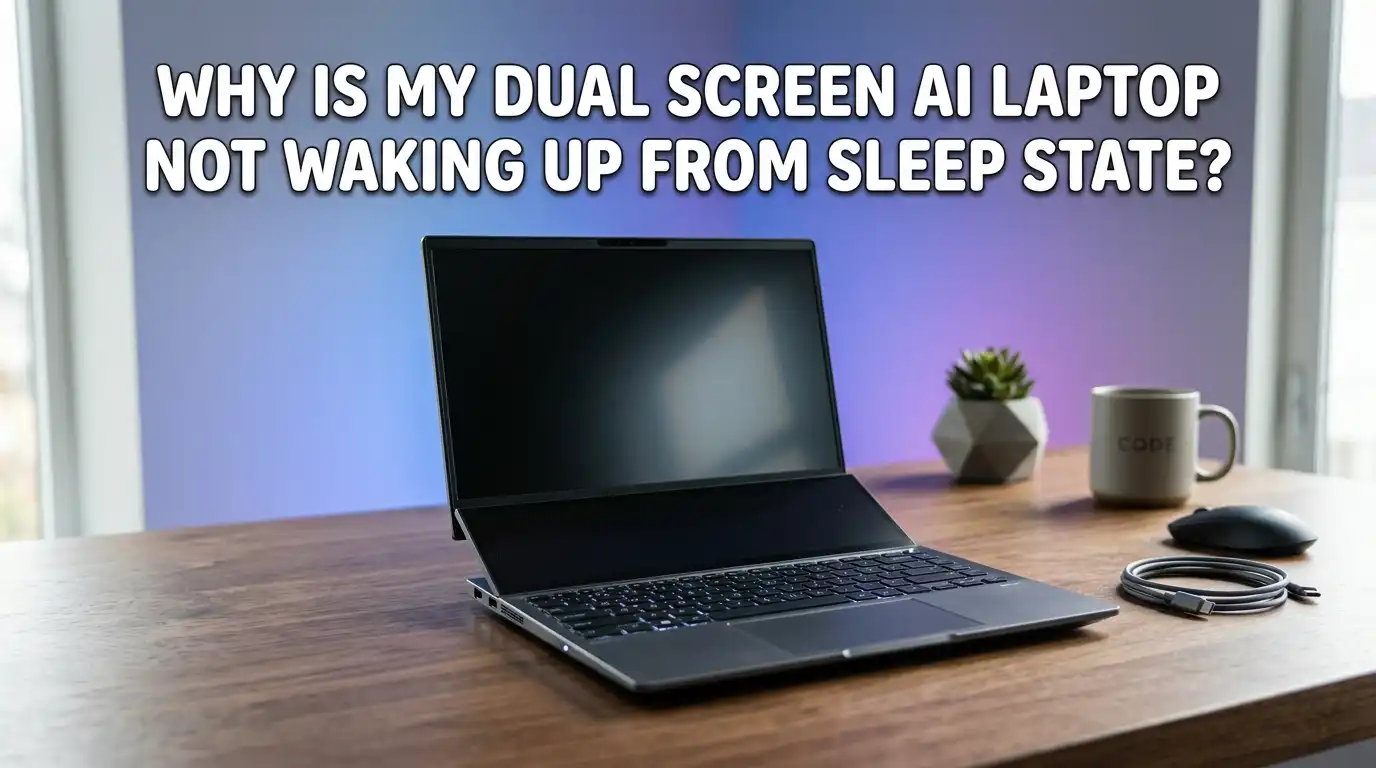
Why Is My Dual Screen AI Laptop Not Waking Up From Sleep State?
You close the lid of your dual screen AI laptop, walk away for a few minutes, and come back to find it completely unresponsive. You tap the keyboard. You move the mouse.
You even press the power button. Nothing happens. Both screens stay dark, and you start to wonder if something is seriously wrong with your machine.
This problem is more common than you think. Dual screen AI laptops like the ASUS Zenbook Duo, Lenovo Yoga Book 9, and similar models run advanced hardware configurations.
Key Takeaways
- Check your power source first. A dual screen AI laptop drains battery faster than a standard laptop, even in sleep mode. If the battery is depleted, the device may have shifted from sleep to hibernation or shut down entirely. Always confirm the charging indicator is active before troubleshooting further.
- Display drivers are the most common cause of sleep wake failures on dual screen systems. Two screens require the GPU to manage double the display output. An outdated or corrupted display driver can prevent one or both screens from turning back on after sleep. Updating or reinstalling your GPU driver fixes this issue in most cases.
- Windows power settings often conflict with dual screen configurations. Features like Hybrid Sleep, Modern Standby, and aggressive sleep timers can cause wake failures. Adjusting these settings in the Control Panel gives you direct control over how your laptop sleeps and resumes.
- BIOS settings may disable wake functions for keyboards and touchpads. Some manufacturers ship laptops with conservative power management in the BIOS. Resetting BIOS to default values or enabling USB wake support can resolve persistent wake issues.
- AI background processes can interfere with sleep states. Many AI laptops run background tasks for neural processing, model updates, and system optimization. These processes can block the system from entering or exiting sleep properly. Disabling unnecessary AI services before sleep can improve reliability.
- A forced shutdown is safe as a temporary fix. If your laptop will not wake up at all, holding the power button for 15 seconds forces a safe shutdown. This does not damage your hardware. After restarting, you can apply the permanent fixes described in this guide.
Understanding Sleep States on a Dual Screen AI Laptop
Dual screen AI laptops handle sleep differently from traditional single screen machines. Your laptop does not simply turn off both displays and wait. It must manage two independent display controllers, an AI coprocessor, and multiple USB or Thunderbolt connections all at once.
Windows uses several sleep states. S0 (Modern Standby) keeps the processor in a low power mode while maintaining network connections. S3 (traditional sleep) cuts power to most components and stores the session in RAM. Hibernation saves everything to the hard drive and powers off completely.
The problem with dual screen laptops is that both displays must reinitialize during the wake process. If the primary screen wakes but the secondary screen does not receive the right signal, the system can appear frozen. AI tasks running in the background may also prevent the processor from reaching a true low power state, which leads to unusual behavior during wake.
Understanding these sleep states helps you identify which stage is failing and apply the correct fix.
Check the Battery and Power Connection
This sounds basic, but it catches more people than you might expect. Dual screen AI laptops consume significantly more power than single screen models, even during sleep. Two OLED or LCD panels, an AI chip, and active memory all draw current while the system rests.
If your laptop was not plugged in when it entered sleep, the battery may have drained completely. In this case, the system transitions from sleep to hibernation and then to a full shutdown. Pressing keyboard keys will not wake a powered off laptop. You need to press the power button or connect the charger first.
Look for the charging LED indicator on the side of your laptop. If it is not lit, the battery may be dead. Plug in the charger, wait two to three minutes, and then press the power button. Many users mistake a dead battery for a system failure.
Pros of checking power first: Fastest and easiest fix. Requires no technical knowledge.
Cons: Does not solve the problem if the battery still has charge.
Update Your Display Drivers
Display drivers are the number one cause of sleep wake failures on dual screen laptops. Your GPU must manage two separate displays with potentially different resolutions and refresh rates. An outdated or corrupted driver can fail to reinitialize one or both screens after sleep.
Open Device Manager by typing it into the Windows search bar. Expand the Display adapters section. Right click your graphics card and select Update driver. Choose the option to search automatically for updated driver software.
For a cleaner fix, visit the website of your GPU manufacturer (Intel, NVIDIA, or AMD) and download the latest driver directly. You can also use a tool like DDU (Display Driver Uninstaller) to completely remove the old driver before installing the fresh one. This eliminates leftover files that may cause conflicts.
Pros: Addresses the most common root cause. Improves overall display stability.
Cons: Requires a restart. DDU requires booting into Safe Mode for the cleanest removal. Some users may find manual driver installation unfamiliar.
Adjust Windows Power Plan Settings
Windows power plans control how your dual screen AI laptop enters and exits sleep. The default settings are often too aggressive for dual screen systems. They may put the laptop to sleep too quickly or enable features that cause wake failures.
Open Control Panel and go to Hardware and Sound, then Power Options. Click Change plan settings next to your active plan. Select Change advanced power settings to open the detailed menu.
Look for these key settings. Set Allow Hybrid Sleep to No under the Sleep section. Hybrid Sleep combines sleep and hibernation, and it frequently causes problems on dual screen machines.
Set Allow Wake Timers to Enable so scheduled tasks can wake the system properly. Also check the Display section and make sure screen timeout values make sense for your use.
Pros: Gives you precise control over sleep behavior. Fixes many persistent wake issues.
Cons: Requires some familiarity with advanced power settings. Wrong changes could affect battery life.
Disable Modern Standby if It Causes Problems
Modern Standby (also called S0 Low Power Idle) is a newer sleep model that keeps your laptop partially active during sleep. It allows email syncing, app updates, and AI background tasks to continue. However, Modern Standby is a known source of wake failures, battery drain, and overheating on many laptops.
Dual screen AI laptops are especially vulnerable. The system tries to keep both display controllers in a ready state while also running AI processes. This creates conflicts that can prevent a clean wake.
To check if your laptop uses Modern Standby, open Command Prompt as administrator and type powercfg /a. If you see “Standby (S0 Low Power Idle)” in the list, your laptop uses Modern Standby. You can disable it through a registry edit. Open Registry Editor, go to HKEY_LOCAL_MACHINE\SYSTEM\CurrentControlSet\Control\Power, and change the value of PlatformAoAcOverride to 0. Create this DWORD value if it does not exist.
Pros: Eliminates a major source of wake and drain issues. Forces the laptop to use traditional S3 sleep.
Cons: Disables background syncing during sleep. Not all laptops support reverting to S3 sleep. Editing the registry carries a small risk if done incorrectly.
Enable Keyboard and Touchpad Wake Permissions
Your dual screen AI laptop might actually be awake, but the keyboard and touchpad are not configured to send wake signals. This is a common default setting on many models. The system is waiting for the power button because it does not recognize input from other devices.
Open Device Manager from the Windows search bar. Expand the Keyboards section. Right click your keyboard device (usually listed as HID Keyboard Device) and select Properties. Go to the Power Management tab. Check the box that says Allow this device to wake the computer. Click OK.
Repeat this process for your mouse or touchpad under the Mice and other pointing devices section. If your laptop has a touchscreen, check the Human Interface Devices section as well. On dual screen laptops, touch input on the secondary screen may also need wake permissions.
Pros: Simple one time fix. Allows multiple input methods to wake the device.
Cons: The Power Management tab is not available on every device. Some laptop manufacturers restrict this setting.
Reset BIOS to Default Settings
Modified BIOS settings can block your laptop from waking properly. This is especially true if you or someone else changed power management, USB power delivery, or display output options in the BIOS. A BIOS misconfiguration can override every Windows setting you change.
To access BIOS on most dual screen AI laptops, turn off the device completely. Then press and hold the F2 key and press the power button. Keep holding F2 until the BIOS screen appears. On some models, you may need to press Del or a specific key combination.
Once inside BIOS, look for an option labeled Load Setup Defaults, Restore Defaults, or Optimized Defaults. Select it and confirm. Save your changes and exit. The laptop will restart with factory BIOS settings.
This step resets all power management configurations to their original state. It is particularly effective if the sleep wake issue started after a BIOS update or manual change.
Pros: Resets all BIOS configurations to safe values. Often fixes deep system level sleep issues.
Cons: Resets all BIOS changes you may have made intentionally. You will need to reconfigure custom BIOS settings afterward.
Refresh the Hibernation File
Windows stores sleep and hibernation data in a system file called hiberfil.sys. This file can become corrupted over time, especially on dual screen systems where two display states must be saved and restored. A corrupted hibernation file causes wake failures and black screens.
Open Command Prompt as administrator. Type powercfg.exe /hibernate off and press Enter. This disables hibernation and deletes the old hiberfil.sys file. Restart your laptop.
After the restart, open Command Prompt as administrator again. Type powercfg.exe /hibernate on and press Enter. This recreates a fresh hibernation file. The new file will not carry over any corruption from the previous one.
This fix is fast and effective. It solves cases where the laptop enters hibernation from sleep but cannot restore the session because the saved data is damaged.
Pros: Takes less than two minutes. No risk to data or settings.
Cons: You will lose any unsaved work from a hibernation session when you turn off hibernation. Does not fix driver or hardware issues.
Run the Windows Power Troubleshooter
Windows includes a built in tool that detects and fixes common power management issues. The Power Troubleshooter scans your system for misconfigured settings, conflicting drivers, and other problems that affect sleep and wake behavior.
Type Troubleshoot settings in the Windows search bar and open it. Click Other troubleshooters. Find the Power option and click Run. The troubleshooter will scan your system and apply fixes automatically. It may adjust timer settings, reset power plan defaults, or repair broken driver configurations.
This tool does not catch every issue, but it handles many of the common ones without requiring manual intervention. It is a good step to try before moving to more advanced fixes like registry edits or system restores. The troubleshooter also generates a report that tells you exactly what it found and changed.
Pros: Automated and easy to use. Fixes common settings issues without manual work.
Cons: Cannot detect hardware failures or deep driver corruption. May not find issues specific to dual screen configurations.
Manage AI Background Services
Dual screen AI laptops run specialized AI services in the background. These services handle tasks like intelligent screen management, camera optimization, voice processing, and predictive performance tuning. On models powered by Intel Core Ultra or AMD Ryzen AI processors, these services may remain active during sleep.
Active AI processes can prevent the CPU from entering a deep sleep state. They can also conflict with the wake process by attempting to resume tasks before the display controllers are ready. This creates a timing conflict that leaves one or both screens dark.
Open Task Manager and click the Startup tab. Look for AI related services from your laptop manufacturer. Disabling nonessential ones can improve sleep and wake reliability. You can also open Services (type services.msc in the search bar) and set AI related services to Manual instead of Automatic.
Pros: Reduces power consumption during sleep. Eliminates timing conflicts during wake.
Cons: Disabling the wrong service could reduce AI features you rely on. Identifying which services are AI related requires some research for your specific model.
Perform a System Restore
If your dual screen AI laptop was waking from sleep without issues before and the problem started recently, a System Restore can take your system back to that working state. This reverses recent changes to drivers, Windows updates, and system files without affecting your personal documents.
Type Create a restore point in the Windows search bar and open it. Click System Restore and follow the prompts. Choose a restore point dated before the sleep wake problem started. Windows will show you which programs and drivers will be affected.
System Restore is especially useful after a Windows update or driver update introduced the problem. Many sleep wake issues appear after cumulative updates change power management behavior. Restoring to a point before that update can instantly fix the issue.
Pros: Reverses problematic changes without losing personal files. Simple guided process.
Cons: Only works if a restore point exists from before the issue. Any software installed after the restore point will need to be reinstalled.
Update BIOS and System Firmware
An outdated BIOS can contain bugs that affect sleep and wake cycles on dual screen laptops. Manufacturers release BIOS updates specifically to fix power management issues, display driver compatibility, and AI processor coordination. Running the latest BIOS version is critical for dual screen systems.
Visit your laptop manufacturer’s support page. Enter your exact model number and download the latest BIOS update. Most manufacturers provide an easy update tool that runs directly from Windows. ASUS offers MyASUS, Lenovo has Vantage, and HP includes Support Assistant.
Before updating, plug in your charger and make sure the battery is above 50%. A power loss during a BIOS update can permanently damage the system. Follow the manufacturer’s instructions carefully. After the update, restart the laptop and test the sleep wake function.
Pros: Fixes known bugs at the firmware level. Can improve overall system stability and AI performance.
Cons: Carries a small risk if power is interrupted during the update. Irreversible in most cases.
Reset Your Laptop as a Last Resort
If none of the above fixes resolve the issue, a full system reset returns your dual screen AI laptop to its factory state. This eliminates any software corruption, driver conflicts, or settings errors that are causing the sleep wake failure.
Go to Settings, then System, then Recovery. Click Reset this PC. You can choose to keep your personal files or remove everything. The “keep my files” option reinstalls Windows while preserving your documents, photos, and other personal data. The “remove everything” option performs a clean installation.
Before resetting, back up all important files to an external drive or cloud storage. After the reset, you will need to reinstall your applications and reconfigure your preferences. Test the sleep wake function immediately after the reset before installing additional software. This confirms whether the issue was software related.
Pros: Eliminates all software and driver issues. Returns the system to a known working state.
Cons: Time consuming. Requires reinstallation of all apps. Does not fix hardware defects.
FAQs
Why does my dual screen laptop screen stay black after waking from sleep?
A black screen after sleep usually means the display driver failed to reinitialize one or both panels. Update your GPU driver from the manufacturer’s website. If the problem continues, use DDU to fully uninstall the driver and perform a fresh installation. Also check that both screens are enabled in Display Settings after waking.
Can I disable sleep mode entirely on my dual screen AI laptop?
Yes. Open Power Options in Control Panel and set “Put the computer to sleep” to Never for both battery and plugged in modes. This prevents the laptop from entering sleep automatically. You can still manually shut down or hibernate the laptop. Keep in mind that disabling sleep increases battery drain if you walk away from the laptop while it runs on battery.
Why does only one screen wake up while the other stays off?
This happens because the two screens may use different display connections or controllers. The primary screen receives the wake signal first, and the secondary screen may not receive its signal due to a driver error or power management conflict. Updating drivers and disabling Hybrid Sleep in power settings often resolves this issue.
Does Modern Standby cause sleep problems on AI laptops?
Yes. Modern Standby keeps parts of the system active during sleep, which can cause battery drain, overheating, and wake failures. Dual screen AI laptops are more affected because two displays and AI processes create additional load during this partial sleep state. Disabling Modern Standby through a registry edit and reverting to traditional S3 sleep fixes this for many users.
Should I contact the manufacturer if none of these fixes work?
Absolutely. If you have tried every solution in this guide and the laptop still fails to wake from sleep, the issue may be hardware related. A faulty display cable, damaged RAM, or a defective power controller can cause persistent sleep wake failures. Contact your manufacturer’s support team and request a hardware diagnostic. If the laptop is under warranty, repairs or replacement may be covered.

Hi, I’m Jessamine Rowell, the founder and voice behind ResizeMake (https://resizemake.com/), a space where I share my love for technology with the world. I write detailed and honest reviews on the latest tech products, gadgets, electronic devices, and trending Amazon items to help readers make smarter buying decisions.