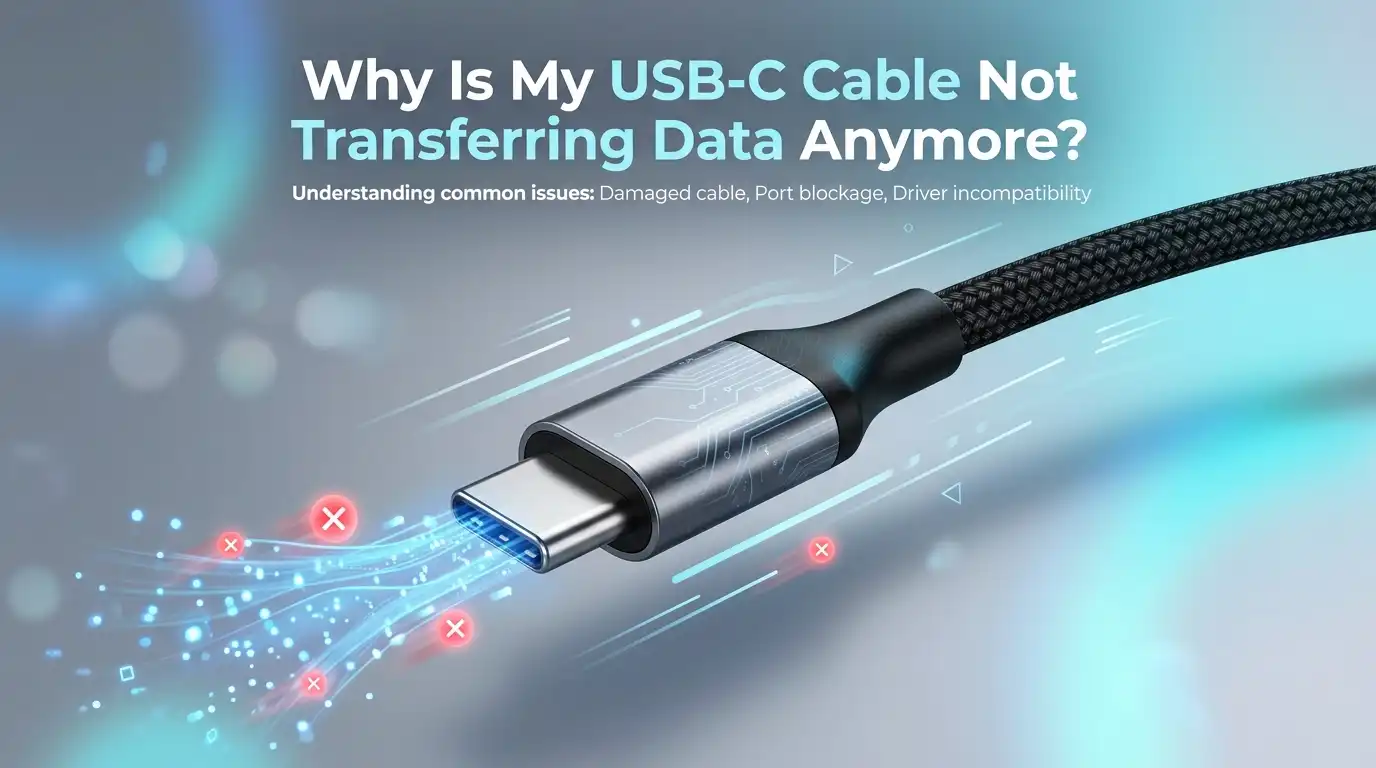
Why Is My USB-C Cable Not Transferring Data Anymore?
Your USB-C cable charges your phone just fine. But the moment you try to move photos, videos, or files, nothing happens. The progress bar freezes. The device never shows up. It feels broken, and you start wondering if you need to buy a new one.
Take a breath. This problem is more common than you think, and most of the time it has a simple cause. A cable that charges but refuses to transfer data is usually not “dead.” Something small is getting in the way, and you can often fix it in a few minutes.
This guide walks you through every reason a USB-C cable stops moving data. You will learn how to test it, clean it, fix software settings, and decide when replacement is your only option.
Key Takeaways
- Many USB-C cables are charge-only. They carry power but have no data wires inside. This is the single most common reason data transfer fails, so always test with a known data cable first.
- Dirt and debris block the data pins. Lint, dust, and pocket fluff pack into the port and stop the tiny data contacts from touching. A gentle cleaning often fixes the problem instantly.
- The wrong USB mode is selected. On Android, your phone may default to “Charging only.” Switching it to “File Transfer” restores data in seconds.
- Drivers and software glitches cause silent failures. Outdated drivers, a frozen port, or a simple restart can block recognition on Windows and Mac.
- Physical damage is permanent. Bent pins, frayed wires, and worn connectors cannot be repaired safely at home. When the hardware is broken, replacement is the smart choice.
- Testing isolates the cause fast. Swap the cable, port, and device one at a time. This tells you exactly what is broken without guessing.
Understand the Difference Between Charge-Only and Data Cables
Not every USB-C cable can move files. This surprises most people. Many cheap cables, and the ones bundled with small accessories, are built only to carry power. They skip the data wires entirely to save money.
A charge-only cable has just two power wires inside. A data cable has four or more wires, including the pair that carries your files. From the outside, both look identical. You cannot tell them apart by looking.
This is why a cable can charge your phone perfectly yet transfer nothing. The power flows, but there is no path for data. If your cable came free with a fan, a lamp, or a power bank, treat it as charge-only until proven otherwise.
Pros of knowing this difference: You stop blaming your phone or computer. You test the right thing first and save hours.
Cons: You often need a second cable to confirm it, and identifying cable type by sight is impossible without testing.
Test With a Known Working Data Cable First
The fastest way to find the problem is to swap the cable. Grab a different USB-C cable that you know transfers data. The cable that came with your phone is usually a safe bet.
Plug it in and try the transfer again. If files move now, your original cable is the culprit. You have found your answer in under a minute.
This test matters because it rules out everything else at once. It tells you the port works, the device works, and the software works. The only difference was the cable.
Make sure the test cable is a true data cable, not another charge-only one. Use a phone manufacturer’s original cable for the most reliable result.
Pros: This is the quickest, cheapest test you can do. It needs no tools and no technical skill.
Cons: You need a spare data cable on hand. If you do not own one, you cannot run this test yet.
Try a Different Port and a Different Device
Sometimes the cable is fine and the port is the real problem. Ports fail silently and often. A worn or glitchy port may still send power while blocking data.
Move the cable to another USB port on your computer. On a Mac or laptop, try every available port. Then plug the same cable into a completely different computer or device.
If the cable works on a second device, your first computer or its port is at fault. If it fails everywhere, the cable itself is likely damaged. This simple swap narrows the cause down fast.
On desktops, prefer the rear USB ports. They connect directly to the motherboard and tend to be more stable than front-panel ports.
Pros: This isolates whether the fault sits in the cable, the port, or the device.
Cons: It requires access to a second device, which not everyone has nearby.
Clean the USB-C Port to Remove Hidden Debris
Lint and dust love USB-C ports. Pocket fluff packs into the bottom over time and stops the data pins from making contact. The port looks clean but is actually blocked.
Turn off your device first. Shine a light into the port and look for grey or fuzzy buildup. Use a wooden toothpick or a plastic pick to gently lift out the debris. Work slowly and never force anything.
After picking out the big pieces, use a short burst of compressed air to clear the rest. Hold the can upright and keep the nozzle a small distance away.
This single fix solves a surprising number of data problems. Many people think their cable died when the port was simply clogged.
Pros: Cleaning is free, fast, and often completely fixes the issue.
Cons: A metal tool can bend the delicate pins. Aggressive cleaning risks permanent damage, so a light touch is essential.
Inspect the Cable and Connectors for Physical Damage
A cable that bends, twists, and gets yanked every day takes real punishment. Internal wires break long before the outside shows any sign. The data wire is thin and snaps easily under stress.
Look closely at both ends of the cable. Check for fraying near the connector, exposed copper, or kinks in the cord. Examine the metal plug for bent or pushed-in pins.
Gently wiggle the cable while a transfer runs. If data flickers on and off as you move it, a wire inside is broken. That cable is no longer reliable for files.
Damaged cables cannot be repaired safely at home. The risk of a short circuit or fire is real, so retire any cable with visible damage.
Pros: A visual check is quick and confirms hardware damage clearly.
Cons: Internal breaks are often invisible. A cable can look perfect yet still be broken inside.
Switch Your Android Phone to File Transfer Mode
Android phones default to “Charging only” when you plug them in. This is a safety feature, not a bug. Your phone hides its files until you tell it to share them.
Connect your phone to the computer. Swipe down from the top of the screen and look for the USB notification. It often says “Charging this device via USB.”
Tap that notification. A menu appears with options. Choose File Transfer or MTP. Your computer will then detect the phone and show its storage.
If the menu does not appear, go to Settings, search for “USB,” open USB Preferences, and pick “File Transfer.” On some phones you must set this each time you connect.
Pros: This fixes the most common Android data issue instantly, with no tools needed.
Cons: You may need to repeat it on every connection. The setting can reset after unplugging.
Update or Reinstall Your USB Drivers on Windows
Windows relies on drivers to talk to USB devices. When a driver goes outdated or corrupt, the port sends power but never recognizes the device for data.
Open Device Manager by right-clicking the Start button. Look for any item with a yellow warning triangle. Right-click your USB device or controller and choose “Update driver.”
If updating does nothing, right-click the device and select “Uninstall device.” Then unplug the cable and restart your computer. Windows reinstalls the driver automatically on the next boot.
This refresh clears most software glitches that block data transfer. It is especially helpful after a Windows update breaks a previously working port.
Pros: Driver fixes are free and solve many silent recognition failures.
Cons: Device Manager confuses some users. Picking the wrong device to uninstall can cause new problems.
Restart Devices and Reset the Connection
A simple restart fixes more tech problems than any other step. Frozen processes and stuck ports clear themselves after a reboot. This is the oldest trick for a reason.
Unplug the cable from both ends. Restart your phone and your computer fully. Wait a moment, then plug everything back in.
On a Mac, a stuck USB port sometimes needs a deeper reset. Shut the Mac down completely, wait thirty seconds, and power it back on. This clears temporary hardware glitches.
Always reconnect the cable after the restart finishes, not during it. Let each device boot fully before plugging back in.
Pros: Restarting costs nothing and fixes temporary software freezes fast.
Cons: It is a temporary fix if the real cause is hardware or a bad driver. The problem may return.
Check Your Mac for Hidden Devices and Settings
Macs handle USB-C a little differently. A connected drive may not pop up on the desktop even when the connection works fine. The data is flowing, but Finder hides it.
Open Finder and check the sidebar under Locations. If the device is missing, go to Finder Preferences, then General, and tick the box for “External disks.” This makes drives appear.
For a deeper look, open Disk Utility from Applications and then Utilities. If the drive shows here but not in Finder, the cable and port work, and the issue is a display setting or file format.
A drive formatted for Windows may show but not open on older Macs. The hardware is fine in that case.
Pros: This reveals whether the connection truly works behind a hidden setting.
Cons: New Mac users find Disk Utility intimidating, and format issues need extra steps to solve.
Rule Out a Worn-Out Cable From Daily Use
Every USB-C cable has a lifespan. Ports are rated for around ten thousand insertions, but cables wear out faster because we bend and pull them constantly.
Think about how old your cable is and how hard it has lived. A cable that rides in a backpack, gets wrapped tightly, or hangs by its cord ages quickly. The thin data wire fails first.
A cable can keep charging long after it stops transferring data. The power wires are thicker and tougher, so they survive while the data wires break.
If your cable is more than a year old and heavily used, age alone may explain the failure. Daily wear is a real and gradual cause.
Pros: Recognizing wear stops you from troubleshooting a cable that is simply finished.
Cons: There is no fix for a worn cable. You confirm the cause only to learn you need a new one.
Match the Cable to the Speed and Standard You Need
USB-C cables follow different speed standards. A cable built for an older, slower standard may struggle or fail with high-speed transfers. Not all USB-C is equal.
Some cables support only USB 2.0 speeds, while others handle USB 3.2 or USB4. If your device expects fast data and the cable cannot keep up, transfers may stall or drop.
This matters most for large files, external SSDs, and video work. A slow cable might still move a few photos yet choke on a big folder.
Check any markings on the cable or its packaging for a speed rating. When in doubt, use the cable that shipped with your high-speed device, since it matches the device’s needs.
Pros: Matching the standard ensures full speed and stable transfers for demanding tasks.
Cons: Speed ratings are hard to read on bare cables, and faster cables cost more.
Know When to Replace the Cable for Good
Sometimes no fix works, and that is okay. A broken data wire inside a cable cannot be repaired safely, and trying to splice it risks a fire. Replacement is the right call.
Replace the cable when you see visible damage, when data flickers as you wiggle it, or when it fails on multiple devices after cleaning. These signs point to dead hardware.
When you buy a new one, choose a cable clearly labeled for data transfer, not charging only. Pick one rated for the speed your device needs. A quality cable lasts far longer.
Treat the new cable gently. Avoid sharp bends, do not yank it by the cord, and store it loosely coiled. Good habits double a cable’s working life.
Pros: A new data cable fully solves the problem and restores reliable transfers.
Cons: Replacement costs money, and buying the wrong type repeats the original issue.
Build Habits That Keep Your Cables Working Longer
Prevention beats repair every time. Small daily habits decide how long your cable survives. A little care saves you money and frustration down the road.
Unplug by gripping the connector, never the cord. Pulling the wire stretches and snaps the thin data lines inside. Hold the plug and pull straight out.
Store cables loosely. Tight wraps and hard kinks crush the wires over time. Coil them in wide loops and avoid bending near the connector ends.
Keep your ports clean by covering devices in dusty bags and checking the port now and then. A clean port protects every cable you plug into it. These simple steps add years of life.
Pros: Good habits cost nothing and prevent most cable failures before they start.
Cons: Habits take time to build, and a single rough yank can still undo months of care.
Frequently Asked Questions
Why does my USB-C cable charge but not transfer data?
The most likely reason is that your cable is charge-only. These cables carry power but have no data wires inside. Other causes include a blocked port, the wrong USB mode on your phone, or a broken data wire. Test with a known data cable to confirm.
How do I know if my USB-C cable supports data transfer?
You cannot tell by looking, since charge-only and data cables look identical. The only sure way is to test it. Plug it into a computer and try moving a file. If files transfer, it is a data cable. If only charging works, it is likely charge-only.
Can a dirty USB-C port stop data transfer?
Yes, and this happens often. Lint and dust pack into the port and block the tiny data pins from touching. The port may still pass power while data fails. Gently clean it with a toothpick and compressed air to restore full contact.
Why does my Android phone only charge and not show files?
Android defaults to “Charging only” for safety. You must switch it to File Transfer mode. Swipe down, tap the USB notification, and choose “File Transfer” or “MTP.” Your computer will then see the phone’s storage and let you move files.
Can I repair a USB-C cable that stopped transferring data?
It is not recommended. A broken internal data wire cannot be fixed safely at home, and splicing risks a short circuit or fire. If cleaning and testing fail, replace the cable with a labeled data cable rated for your device’s speed.
How long does a USB-C cable last?
It depends on use. Ports handle around ten thousand insertions, but cables wear faster from bending and pulling. A gently used cable can last for years, while a roughly handled one may fail in months. The thin data wire usually breaks before the power wires do.

Hi, I’m Jessamine Rowell, the founder and voice behind ResizeMake (https://resizemake.com/), a space where I share my love for technology with the world. I write detailed and honest reviews on the latest tech products, gadgets, electronic devices, and trending Amazon items to help readers make smarter buying decisions.